

Every application season has the same milestones. What separates the students who glide through them from the students improvising in November is rarely effort. It is whether the milestones were written down, dated, and shared with whoever is helping. That is the entire job of a roadmap app, and most of them do only half of it: they track deadlines beautifully and forget the money milestones completely.
The checklist, app or not
- School list finalized (reach, target, safe)
- Counselor waiver meeting completed
- Test dates booked and prepped
- WES or credential evaluation ordered, if needed
- Recommenders asked, six to eight weeks out
- Essays drafted per school
- Fees and waivers confirmed per school
- Applications submitted
- Portals verified, all items received
- Financial documents ready for the visa stage
Ten boxes. The app's job is to keep this visible, dated, and shared with whoever helps you. Everything else a tracker sells is decoration.
The milestone that pays for the app
Box seven, fees and waivers confirmed per school, is the one with money attached. Our Budget Builder database covers 139 program entries, and 118 of them list a waiver or exemption route. Spread across fee bands, the coverage looks like this:
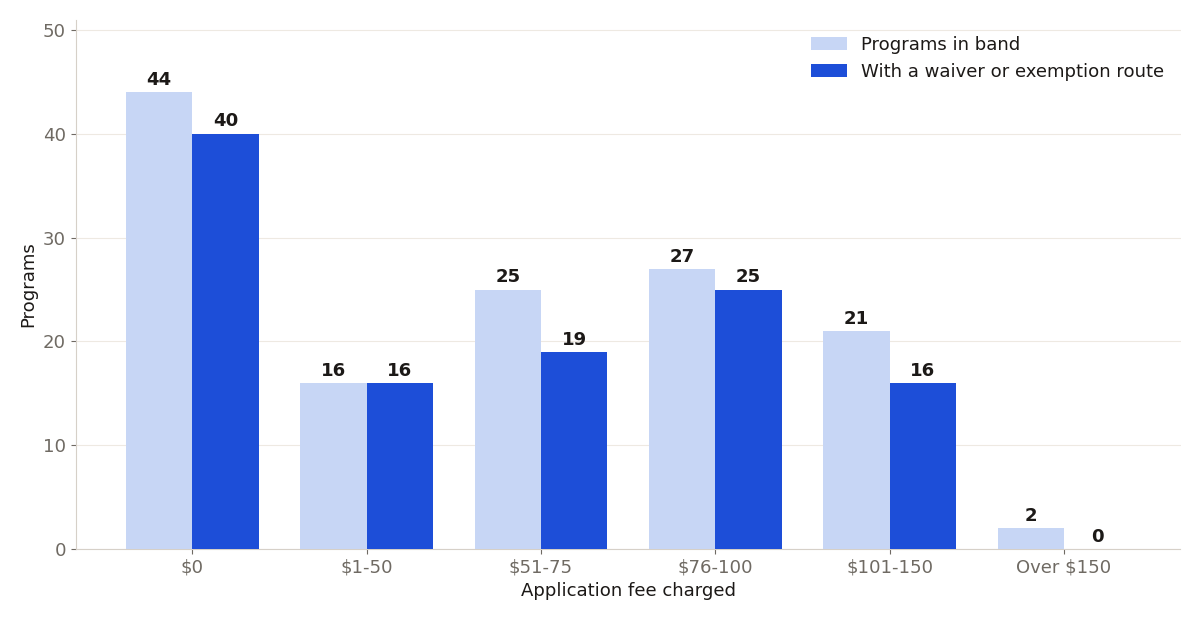
Read the pattern, because it changes how you schedule. Every band below $150 has waiver routes at most of its programs: all 16 programs in the $1 to $50 band, 25 of 27 in the $76 to $100 band, and 16 of 21 even in the $101 to $150 band. The only band with none is the pair of most expensive entries in the database, over $150. Even the $0 band is instructive: 40 of its 44 programs still list a waiver or exemption route, because exemption rules are how many of them are free for some applicants rather than for everyone. The lesson for your calendar is direct. The waiver milestone is not one box ticked in October. It is a per-school research task with its own lead time, and a roadmap app that cannot hold a waiver status next to each school is missing its most valuable column.
Notice what the checklist does not contain: a single line for the decision stage. That is deliberate. Deposits, deferral decisions, and waitlist replies all arrive after the applications close, and each deserves its own short list when it lands. A roadmap app that tries to run the whole two years as one flat list buries the urgent under the eventual. The seasons that work are run in stages, with the fee and waiver stage finished before the submission stage begins, because a waiver discovered after payment is worth exactly nothing. Sequence is the feature. Everything else is interface.
What to demand from the app
Whatever you use, hold it to that standard: a fee field and a waiver field on every school, a date on every milestone, and a shared view for the counselor or parent helping you. Then work the list in order. The students who verify portals (box nine) catch the missing transcript in October. The ones who skip it find out in March, when nothing can be fixed.
One working habit ties the checklist together: every box gets a date the day it is created, not the day it is finished. The waiver meeting is booked six weeks before the first waiver deadline, not the night before. The evaluation is ordered when the school list firms up, because credential services slow down exactly when everyone else remembers them. A roadmap app makes this trivially visible, which is the point. Ten undated boxes are a poster. Ten dated boxes are a plan, and plans are what keep a season boring.
Total the season as you track it
Milestones tell you when; the budget tells you how much. Pair the checklist with the free Application Budget Builder, which prices every program on your list from the same database behind the chart above, and read our guide to profile-building roadmap apps if you are choosing between trackers. A season run on a dated checklist and a priced list is a boring season, and boring is the goal. Sources: Common App