

No. Almost never.
Application fees for universities are non-refundable at virtually every institution, and schools say so plainly in the payment terms nobody reads. Paid the fee and decided not to apply? Gone. Paid it twice by accident? You can ask, and a few bursar offices will quietly reverse a clear duplicate charge, but treat that as a favor, not a right. Withdrew the week after submitting? Still gone. The fee buys the reading of your file, and the reading counts as delivered the moment your application enters the queue.
What is actually at stake
It helps to know the size of the loss before you risk it. We track application fees across 139 program entries in our Budget Builder database, 135 of them with a recorded fee. The spread looks like this:
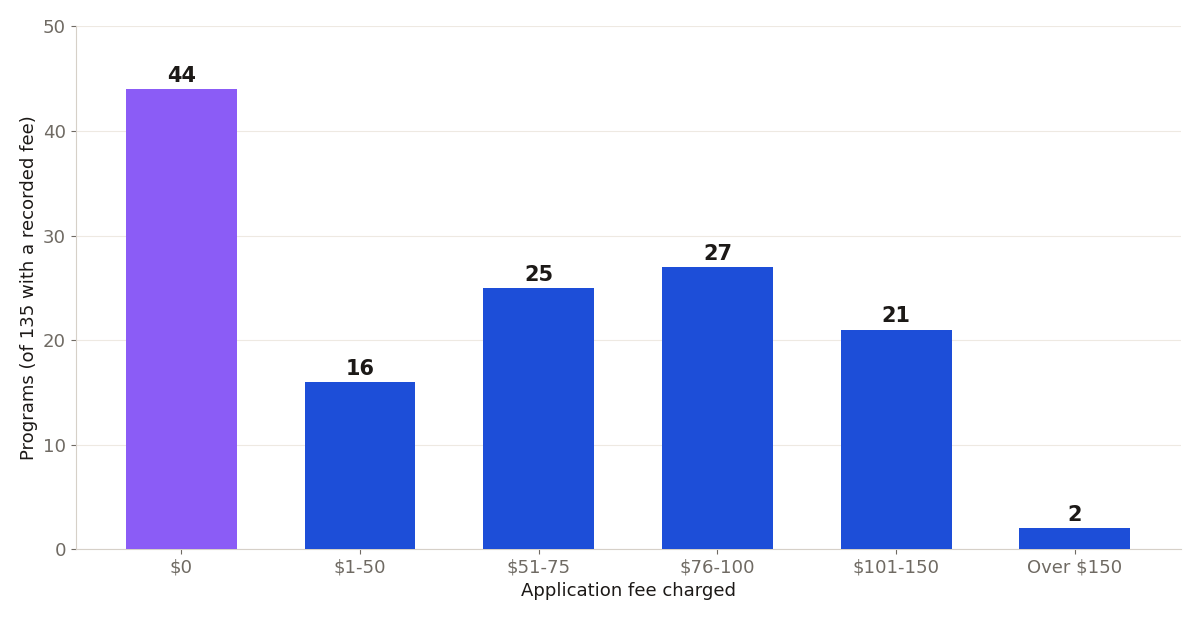
The middle of the market is $51 to $100: 52 of the 135 fee-recorded programs sit in those two bands. Among the 91 programs that charge anything at all, the median fee is $80 and the most expensive entry in the database is $188. International applicants should check the number twice: 86 entries record a separate international fee, and 15 of them charge international applicants more than domestic ones, so the amount at risk is not always the headline figure on the program page. At the other end, 44 programs charge $0, which is why the refund question matters less than the selection question. Money sent to a $0 program never needs refunding. Money sent at the $80 median, multiplied across a season of eight or ten applications, is $640 to $800 that no policy will give back.
The exceptions people hope for
Three situations come up every season, and they are not equal. A duplicate payment caused by a portal error is the strongest case: keep the screenshots and both receipts, and contact the admissions office, not your bank, first. A program that is cancelled or closed after you paid is the second: schools do refund when the review you paid for never happens, though it can take a term to arrive. The third, changing your mind, has no case at all. Neither does paying the wrong portal, which happens more than anyone admits when the undergraduate and graduate applications for the same university sit on lookalike systems. Double-check which application you are in before the payment screen, not after.
The waiver rule that saves the fee entirely
If you qualify for a fee waiver, get it approved before you pay. Retroactive waivers do not exist. A waiver requested after payment is a request for a refund by another name, and it meets the same answer. This is the single most expensive sequencing mistake in an application season, and it is completely avoidable: 118 of the 139 programs in our data list a waiver or exemption route, so for most applicants the choice is not between paying and not applying. It is between asking first and asking too late. Counselors can batch waiver approvals in the fall, and many programs decide case by case when an applicant simply writes and asks. Both routes close the moment the payment goes through.
Before you pay any fee
- Do not pay until the application is complete and you are certain you are submitting.
- Confirm you are on the correct application. Undergraduate and graduate portals look alike.
- If a waiver might apply to you, request it and wait for the decision before paying.
- Watch for duplicate charges on slow portals, and screenshot every payment confirmation.
- Keep the receipt. If anything goes wrong, the receipt is the whole conversation.
Price the season before it starts
The refund question usually arrives after the money leaves. The better time to ask it is in September, with the whole season priced in front of you. The free Application Budget Builder totals your list program by program, fees and waiver routes side by side, so you can see which payments are at risk before you make them. Run your list through it, move the waiver requests to the top of the calendar, and the honest answer to the refund question stops mattering, because you never needed to ask it. Sources: Common App